|
36° Stormo
|
 |
Il 12° Gruppo Volo è stato costituito il 10 maggio 1917 sull’aeroporto di Belluno e posto alle dipendenze del nuovo Comando Aeronautico della IV Armata, in organico comprendeva la 48ª Squadriglia Caudron, la 2ª Sezione Nieuport dell’83ª Squadriglia, la 3ª Sezione della 35ª e 113ª Squadriglia, nei mesi successivi si aggiunsero la 115a e la 117a Squadriglia SAML e in trasferimento dal II Gruppo la 22a e la 27a. Subito dopo la costituzione fu immediatamente impegnato in guerra con il compito primario di effettuare fotografia aerea e di osservazione, l’osservazione e l’eventuale riporto di bersagli consentiva all’artiglieria di eseguire un più preciso puntamento di tiro, la dotazione di velivoli era costituita da: Spad (Sociéte Pour l'Aviation et ses Dérivés) A2 e A3, SAML 2 (Società Anonima Meccanica Lombarda), Nieuport, Sia (Società Italiana Aviazione) 7B, Caudron, Savoia-Pomilio SP.3.
Nella primavera del 1918 fu stanziato a Cittadella, nel successivo mese di luglio invece a Casoni, e nel finire dell’anno a Comina.
Nel febbraio del 1919 era inquadrato nel Comando Aeronautica della VI Armata, ad aprile il reparto era ancora a Casoni e infine fu sciolto prima dell’inizio dell’estate del 1919.
Il 12° Gruppo fu ricostituito il 19 giugno del 1936, questa volta in seno al 50° Stormo d’Assalto e dislocato a Ciampino Sud, in organico erano presenti le Squadriglie 159a, 160a e 165a, mentre i velivoli in dotazione erano i Caproni Ap.1, i Breda Ba.64 e Ba.65
Nel 1938 il 12° fu trasferito a Treviso Sant’Angelo.
Con l’inizio delle velleità belliche della Seconda guerra mondiale, nella primavera del 1939 il Gruppo fu trasferito in Libia prima a Berka (Bengasi) poi, nel giugno del 1940 a Sorman (Tripoli), laddove apprese della dichiarazione di guerra alla Francia ed alla Gran Bretagna da parte italiana. La prima missione bellica del 12° Gruppo fu svolta il 13 giugno del 1940 con dei bimotori da ricognizione Caproni Ca-310 Libeccio, e fino a gennaio del 1941 il Gruppo partecipò a moltissime azioni di guerra subendo numerose perdite, tra le quali ricordiamo la Medaglia d’Oro al Valor Militare Capitano Antonio Dell’Oro, allora Comandante della 159a Squadriglia.
Al termine della campagna libica, nel febbraio del 1941, il Gruppo fece rientro in patria a Treviso Sant-Angelo per riorganizzarsi e ricostituire gli organici, il Gruppo rimase Autonomo e iniziò la trasformazione in Caccia Terrestre.
Dal 16 marzo il reparto fu trasferito a Pisa San-Giusto e posto alle dipendenze del 52° Stormo, subito iniziarono le consegne dei nuovi velivoli FIAT G.50Bis.
Dopo pochi mesi il neo costituito Gruppo Caccia Terrestre riprende le attività belliche ancora in Africa e ancora in Libia, questa volta con i compiti di scorta convogli, scorta trasporti aerei e difesa aerea in particolar modo nella zona del porto di Tripoli.
L’11 agosto del 1942 il Gruppo rientrò nuovamente in Italia e concorrerà alla difesa della città di Torino.
Nel febbraio del 1943 il Gruppo fu trasferito sull’aeroporto di Sciacca dove, il 20 giugno fu sciolto.
Poco più di un anno dopo (30 aprile 1944) il 12° fu ricostituito e fu inquadrato nel 4° Stormo, come organico gli furono sottoposte la 73a e la 91a Squadriglia, mentre i velivoli in dotazione erano gli MC.202 e MC.205.
Dal mese di giugno il reparto fu dislocato a Campo Vesuvio per iniziare la transizione sul Bell P-39 Airacobra.
L’11 settembre del 1944 il Gruppo si trasferì sul campo di Leverano.
Ancora una chiusura, questa volta il 10 ottobre 1945, mentre era dislocato a Lecce-Galatina.
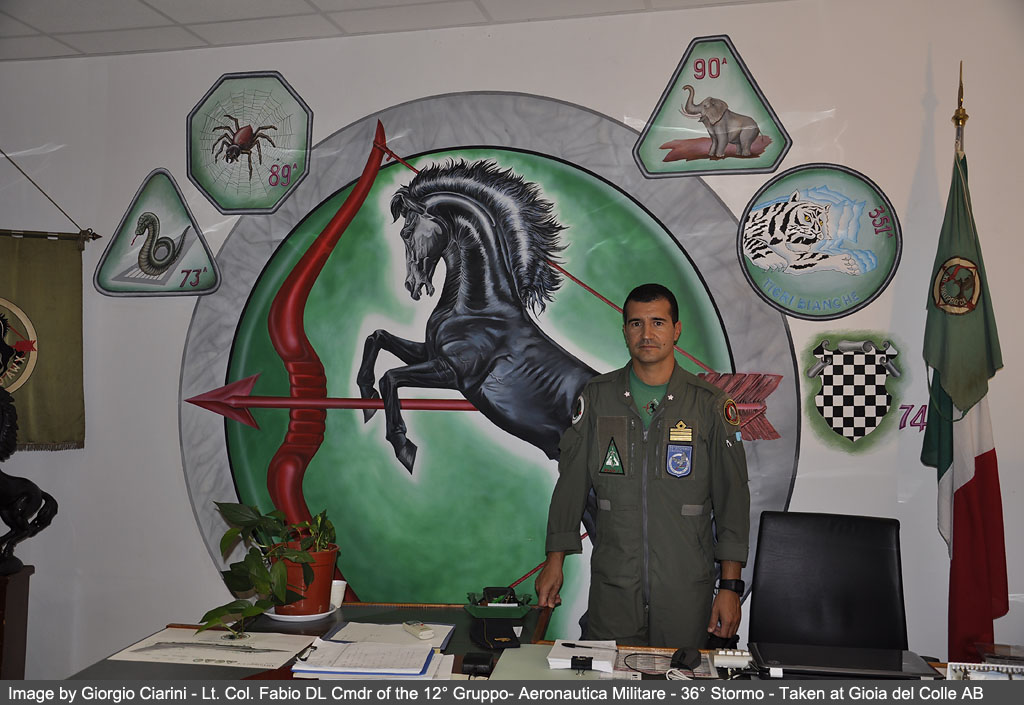
Per rivedere il 12° Gruppo dobbiamo attendere il 1° settembre del 1953 in piena Guerra Fredda, questa volta sotto il mitico simbolo del “Cavallino Rampante” del 4° Stormo Caccia e come nuova “location” l’aeroporto di Napoli-Capodichino, i velivoli in dotazione erano i DH.100 Vampire.
Nei primi mesi del 1956 il 12° fu trasferito a Pratica di Mare per effettuare la conversione sull’F 86E Sabre. Il 10 marzo del 1959 con il trasferimento a Grosseto il Gruppo ha una triplice dipendenza, addestrativa dal Comando dell’Aerobrigata, disciplinare dal Comando di Aeroporto, operativa dallo Stato Maggiore della III ZAT. Nel 1961 tutti i Gruppi del 4° Stormo (9°, 10° e 12°) effettuano la conversione sull’F 86K. La situazione non mutò con il trasferimento avvenuto il 24 settembre del 1963 a Gioia del Colle, dipendenza dal Comando Base Aerea, operativa dal Comando della III Regione Aerea, l’inquadramento rimase sotto la 4a Aerobrigata (nuova denominazione per gli Stormi con tre Gruppi di Volo in organico). “Status” di Gruppo Autonomo che rimase invariato per i tre anni successivi dal trasferimento in terra pugliese, almeno fino al 1° luglio del 1966 quando concorse con il 156° Gruppo alla ricostituzione del 36° Stormo Caccia.
Da dicembre del 1971 fino a Luglio del 1995 gli “Strali” (denominazioni dei Gruppi di Volo acquisite nel finire del Secondo conflitto mondiale) operano per ventiquattro anni ininterrottamente con il mitico “Spillone” o “Cacciatore di Stelle”, nelle versioni F 104S prima e F 104S ASA dopo, nel luglio del 1995 arrivano i primi Tornado ADV (Air Defence Variant) che sostituiranno gli “anziani” Starfighter.
Il nuovo velivolo incrementa la capacità operativa del 12° Gruppo, che subito dopo la TACEVAL (TACtical EVALuation) è chiamato a operare nell’ambito dell’operazione “Alba”, operazione voluta dall’ONU a seguito d’insurrezioni civili in Albania. Più tardi con l’aggravarsi della situazione socio-politica nella regione balcanica, da marzo a giugno del 1999 il 12° Gruppo opera per la prima volta dopo il Secondo conflitto mondiale, in uno scenario di guerra reale nell’ambito dell’operazione “Allied Force”. Al termine delle operazioni, riceve unanimi attestazioni di stima dagli alti comandi militari nazionali e NATO.
Nel 2004 terminato il contratto di leasing con il Ministero della Difesa britannico, tutti i velivoli Tornado ADV vengono restituiti alla Royal Air Force, gli ultimi due Tornado hanno lasciato la base pugliese nel dicembre 2004.
In attesa di essere dotato del velivolo Eurofighter F 2000A “Typhoon”, in ritardo nelle consegne all’Aeronautica Militare per problemi relativi allo sviluppo, si è optato già dal giugno del 2004 a dotare il Reparto di velivoli Aermacchi MB 339CD, velivoli che sono stati prelevati dalla linea del 61° Stormo; in questo breve lasso di tempo il 12° Gruppo si è trovato ad operare contemporaneamente con due macchine differenti e con ruoli nettamente differenti. I Tornado ADV continuarono a garantire il servizio di allarme per la protezione dello spazio aereo nazionale (fino a settembre 2004) e con il nuovo velivolo MB 339CD, visto il mutato scenario mondiale di minaccia asimmetrica di natura terroristica, si è creato il nuovo ruolo di “Slow Mover Interceptor”, che prevede di intercettare piccoli velivoli o elicotteri intenti a svolgere attività terroristiche ipoteticamente durante i summit internazionali o eventi di rilevanza mondiale. Infatti il 12° durante la transizione sul nuovo velivolo ha svolto molteplici missioni di pattugliamento armato, per esempio sui cieli di Roma in occasione della firma della costituzione europea, oppure citando solo i più importanti, il funerale di Papa Giovanni Paolo II, l’elezione a Pontefice di Papa Benedetto XVI, le Olimpiadi invernali di Torino, la visita in Italia dei presidenti Putin e Bush.
Tra l’altro il “339CD” è stato un ottimo vettore per mantenere i piloti Combat Ready in attesa dell’arrivo dei “Typhoon”, perché è un velivolo utilizzato normalmente come addestratore avanzato, punto di passaggio tra gli addestratori basici e i caccia di nuova generazione.
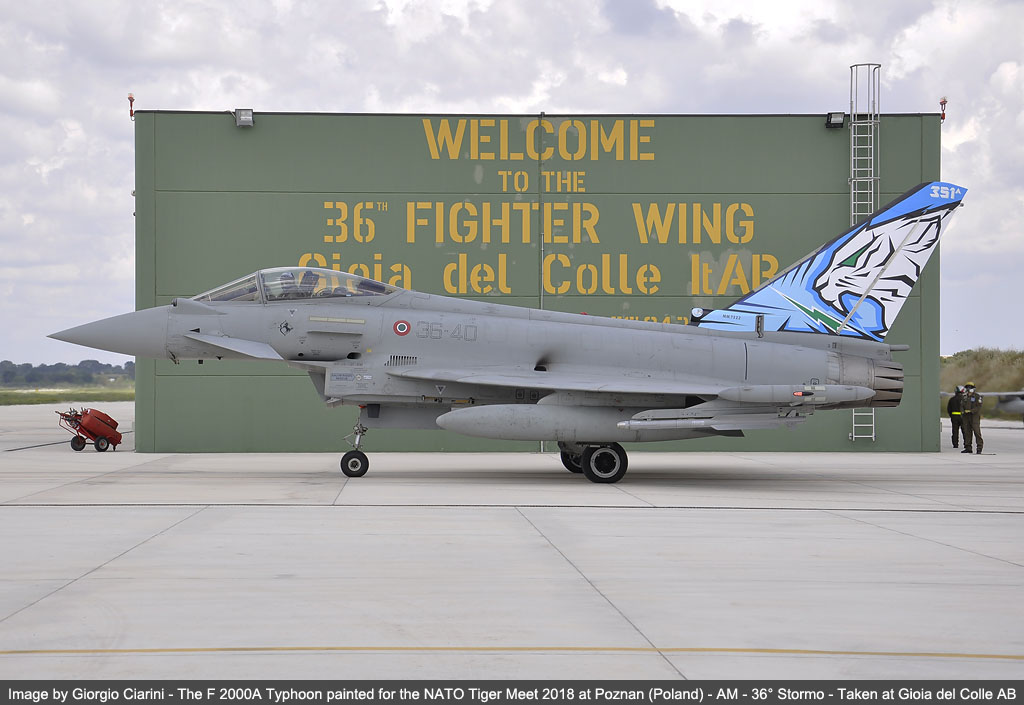
Con l’arrivo dei primi Eurofighter, i primi quattro esemplari sono giunti a Gioia del Colle il 1° ottobre del 2007, sono stati restituiti gli Aermacchi al 61°Stormo e il 12° ha ripreso ad addestrarsi per svolgere al meglio il Servizio di Sorveglianza dello Spazio Aereo Nazionale (SSSA).
In poco meno di un anno dall’arrivo dei primi caccia, i piloti del Gruppo hanno celebrato le 1.000 ore di volo sul Typhoon e questo traguardo è stato raggiunto grazie all’impegno del personale specialista, affiancato dai tecnici della ditta Alenia, facendo in modo che le normali difficoltà per un sistema d’arma così giovane fossero superate brillantemente.
Dall’inizio del 2009 (5 gennaio) dopo circa cinque anni di assenza gli “Strali” tornano a pieno titolo nel sistema integrato di difesa nazionale con turni di “QRA” (Quick Reaction Alert) insieme ai colleghi di Grosseto, Cervia e Trapani, un compito che porta l’importante base pugliese a diventare il punto focale della difesa aerea del mediterraneo. |
 |
 |
 |
|
|
|
English translation
The 12° Gruppo Volo was formed on 10 May 1917 at Belluno Airport and placed under the new Comando Aeronautico (Air Force Command) of the IV Armata (Army), including the 48ª Squadriglia Caudron, the 2ª Sezione Nieuport of the 83ª Squadriglia, the 3ª Sezione of the 35ª and 113ª Squadriglia, in the following months the 115ª and 117ª Squadriglia SAML were added and transferred from 2° Gruppo the 22ª and 27ª. Immediately after the constitution he was immediately engaged in war with the primary task of carrying out aerial photography and observation, the observation and possible reporting of targets allowed the artillery to perform a more precise aiming of fire, the aircraft were equipped with: Spad (Sociéte Pour l'Aviation et ses Dérivés) A2 and A3, SAML 2 (Società Anonima Meccanica Lombarda), Nieuport, Sia (Società Italiana Aviazione) 7B, Caudron, Savoia-Pomilio SP.3.
In the spring of 1918 he was stationed in Cittadella, in the following month of July instead in Casoni, and at the end of the year in Comina.
In February 1919 he was part of the Comando Aeronautica of the 6ª Armata, in April the unit was still in Casoni and was finally disbanded before the beginning of the summer of 1919.
On the 12° Gruppo was reconstituted on the 19th of June 1936, this time in the within the 50° Stormo d'Assalto and stationed at Ciampino Sud, there were the Squadriglia 159ª, 160ª and 165ª, while the aircraft were the Caproni Ap.1, Breda Ba.64 and Ba.65
In 1938 the 12° was transferred to Treviso Sant'Angelo.
With the beginning of the war ambitions of the World War 2, in the spring of 1939 the Gruppo was transferred to Libya first to Berka (Benghazi) then, in June of the 1940 at Sorman (Tripoli) when he learned of the declaration of war against France and Great Britain by the Italian side. The first war mission of the 12° Gruppo was carried out on June 13, 1940 with twin-engine reconnaissance Caproni Ca-310 Libeccio, and until January 1941 the Gruppo participated in many war actions suffering numerous losses, including the Gold Medal of Military Valor Captain Antonio Dell'Oro, then Commander of the 159ª Squadriglia.
At the end of the Libyan campaign, in February 1941, the Gruppo returned home to Treviso Sant-Angelo to reorganize and reconstitute the staff, the Gruppo remained autonomous and began the transformation into Caccia Terrestre.
From March 16, the unit was transferred to Pisa San-Giusto and placed under the 52° Stormo, immediately began deliveries of new aircraft FIAT G.50bis.
After a few months the newly formed Gruppo Caccia Terrestre resumes the war activities still in Africa and again in Libya, this time with the tasks of escorting convoys, air escort and air defense especially in the area of the port of Tripoli.
On August 11, 1942 the Gruppo returned to Italy and will compete for the defense of the city of Torino.
In February 1943 the Gruppo was transferred to Sciacca airport where, on June 20 it was disbanded.
A little more than a year later (April 30, 1944) the 12° was reconstituted and was framed in the 4° Stormo. The 73ª and 91ª Squadriglie were assigned to him, while the aircraft were the MC.202 and MC.205.
By June, the Unit was stationed at Campo Vesuvio to begin the transition on the Bell P-39 Airacobra.
On September 11, 1944, the Gruppo moved to the Leverano airfield.
A further closure, this time on 10 October 1945, while he was stationed in Lecce-Galatina.
To review the 12° Gruppo we have to wait for the 1st of September 1953 in the middle of the Cold War, this time under the legendary symbol of the "Cavallino Rampante" (Prancing Horse) of the 4° Stormo Caccia and as a new "location" the airport of Napoli-Capodichino, the aircraft supplied were the DH.100 Vampire.
In the early months of 1956, the 12° was transferred to Pratica di Mare to carry out the conversion on the F 86E Sabre. On March 10, 1959 with the transfer to Grosseto the Gruppo has a threefold dependence, training from the Aerobrigata Command, disciplinary from the Comando Aeroporto, operating from the General Staff of the III ZAT. In 1961, all the Gruppi of the 4° Stormo (9°, 10° and 12°) carried out the conversion on the F 86K. The situation did not change with the transfer on September 24, 1963 to Gioia del Colle, dependent on the Air Base Command, operational by the Comando III Regione Aerea, the classification remained under the 4ª Aerobrigata (new name for the Stormo with three Gruppi Volo in organic). "Status" of Gruppo Autonomo that remained unchanged for the three years following the transfer to Puglia land, at least until 1 July 1966 when it ran with the 156° Gruppo to the reconstitution of the 36° Stormo Caccia.
From December 1971 until July 1995 the "Strali" (names of the Gruppi di Volo acquired in the end of the World War 2) operate for twenty-four years without interruption with the legendary "Spillone" or "Starfighter" in July 1995, the first Tornado ADV (Air Defence Variant) arrived, replacing the "elderly" Starfighter.
The new aircraft increases the operational capacity of the 12° Gruppo, which immediately after the TACEVAL (Tactical Evaluation) is called to operate as part of the operation "Alba", an operation commissioned by the UN following civil insurrections in Albania. Later with the worsening of the socio-political situation in the Balkan region, from March to June of 1999 the 12° Gruppo operates for the first time after the World War 2, in a scenario of real war under the operation "Allied Force". At the end of the operations, it receives unanimous statements of esteem from the national and NATO military high commands.
In 2004, after the lease agreement with the British Ministry of Defence, all Tornado ADV aircraft were returned to the Royal Air Force, the last two Tornados left the Puglia air base in December 2004.
Waiting to be equipped with the aircraft Eurofighter F 2000A "Typhoon", late in delivery to the Aeronautica Militare for development problems, has opted since June 2004 to equipment the Unit of aircraft Aermacchi MB 339CD, aircraft that have been taken from the line of the 61° Stormo; in this short period of time the 12° Gruppo found itself operating simultaneously with two different machines and with clearly different roles. Tornado ADV continued to provide the national airspace protection alert service (until September 2004) and with the new MB 339CD aircraft, given the changed world scenario of asymmetric terrorist threat, the new role of "Slow Mover Interceptor", which involves intercepting small aircraft or helicopters intent on carrying out terrorist activities hypothetically during international summits or events of global importance. In fact, on the 12°, during the transition on the new aircraft he carried out several armed patrol missions, for example on the skies of Rome on the occasion of the signing of the European Constitution, or citing only the most important, the funeral of Pope John Paul II, the election of Pope Benedict XVI as Pope, the Winter Olympics in Torino, the visit to Italy of Presidents Putin and Bush.
Among other things, the "339CD" was an excellent carrier to keep the Combat Ready pilots waiting for the arrival of "Typhoon", because it is an aircraft normally used as an advanced trainer, a transition point between basic trainers and new generation fighters.
With the arrival of the first Eurofighter, the first four examples arrived in Gioia del Colle on October 1, 2007, the Aermacchi were returned to 61° Stormo and the 12° resumed training to perform at best the Sorveglianza dello Spazio Aereo Nazionale (SSSA or National Airspace Surveillance Service).
In less than a year from the arrival of the first fighters, the Gruppo pilots celebrated the 1,000 hours of flight on the Typhoon and this goal was achieved thanks to the commitment of the specialist staff, assisted by the technicians of the company Alenia, making sure that the usual difficulties for such a young weapon system were overcome brilliantly.
Since the beginning of 2009 (5 January) after about five years of absence the "Strali" return fully in the integrated system of national defense with turns of "QRA" (Quick Reaction Alert) together with colleagues from Grosseto, Cervia and Trapani, a task that brings the important Puglia base to become the focal point of air defense of the Mediterranean.
|
|