|
4° Stormo
|
 |
Il Gruppo Efficienza Aeromobili del 4° Stormo nasce nell’aprile del 2005 dall’accorpamento di quattro entità che fino al 2005 avevano operato in maniera autonoma all’interno della base di Grosseto: il 4° RMV (Reparto Manutenzione Velivoli), le Sezioni Tecniche del 9° e 20°Gruppo e la 604ª Squadriglia Collegamenti. In aderenza con le direttive dello Stato Maggiore Aeronautica, infatti, tutte le risorse di personale manutentore esistenti in una base dovevano essere raggruppate, per fini sinergici, e messe sotto un unico Comando che rispondesse direttamente al Comandante di Stormo, senza dirette dipendenze con gli “utenti” ovvero con i Gruppi di Volo. Appena nato, quindi, il GEA ha dovuto affrontare la sfida di riuscire ad amalgamare uomini con formazione, cultura manutentiva e tradizioni diverse, il tutto avendo di fronte un Sistema d’Arma innovativo ed esigente come il Typhoon.
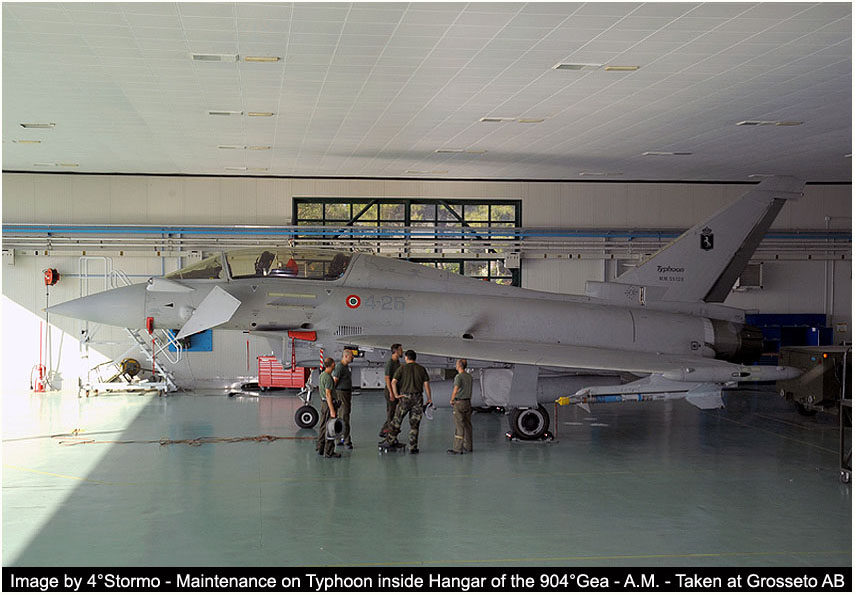
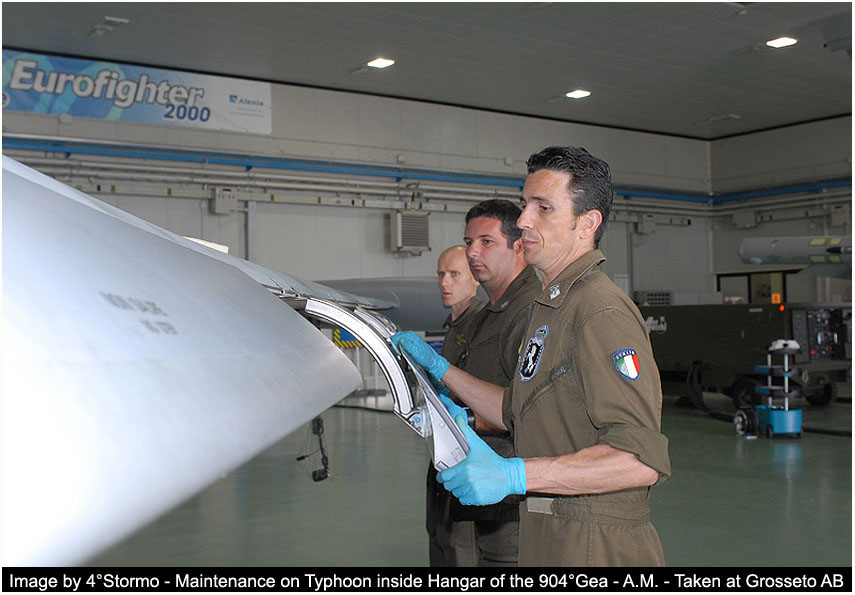
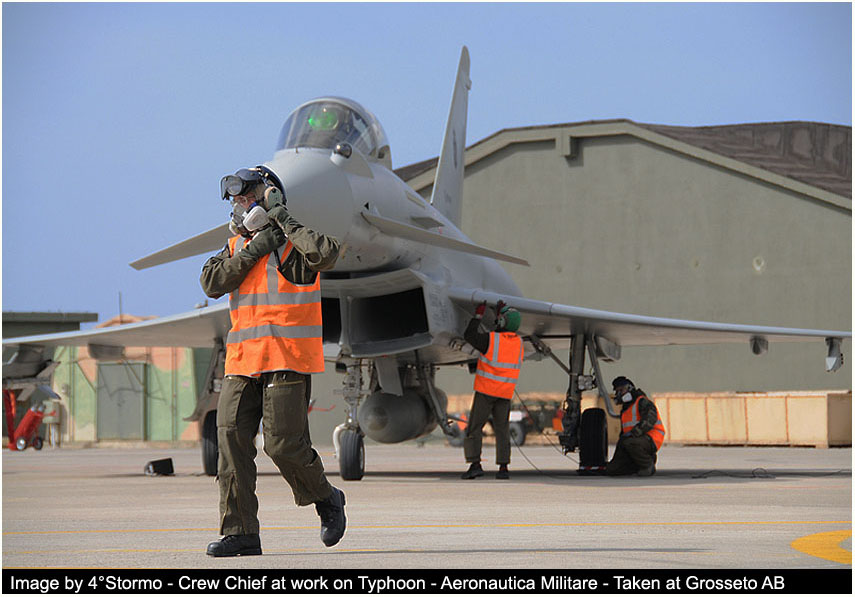
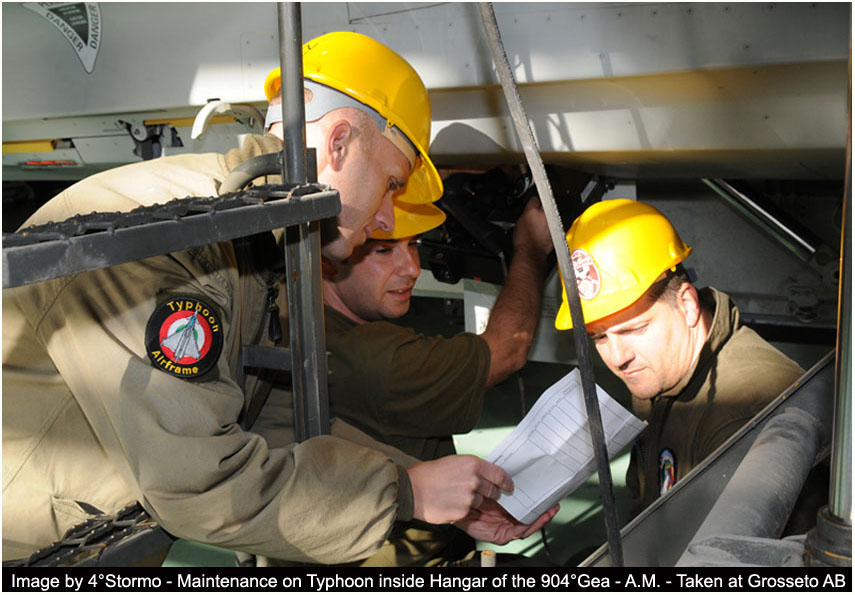
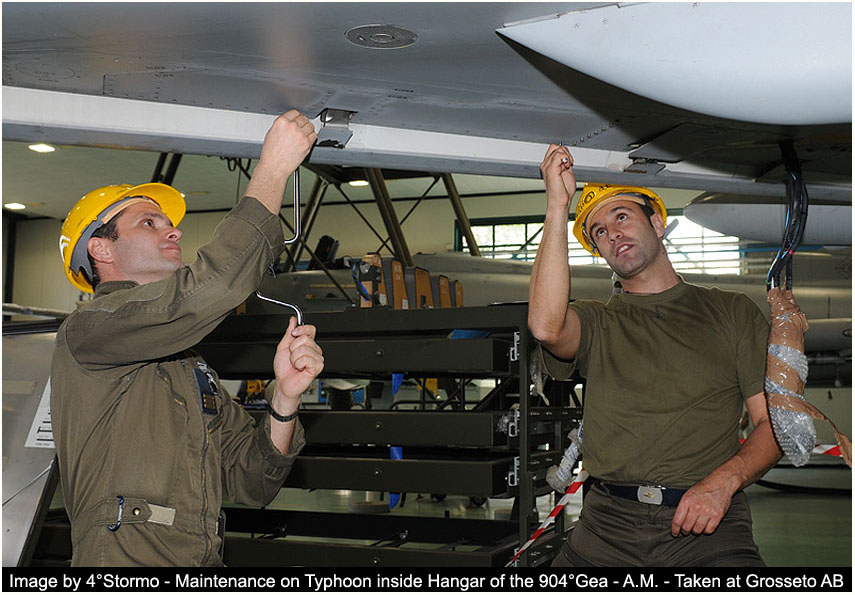
Oggi il GEA svolge attività di manutenzione di 1° Livello Tecnico rinforzato su tutte le componenti del velivolo, quindi struttura, avionica, impianto propulsivo, armamento, impianto carburante e sistemi di sicurezza. All’attività prettamente manutentiva, che garantisce l’efficienza degli aeromobili assegnati, si aggiunge poi l’attività di linea volo, con l’assistenza diretta al personale navigante durante le fasi di pre e post volo.
La nuova struttura ha imposto metodi e mentalità differenti dal passato, e la trasformazione non è stata indolore. Prima ogni Gruppo di Volo aveva alle sue dirette dipendenze il personale tecnico addetto alla linea di volo, personale che lavorava a stretto contatto con i piloti dello stesso Gruppo e con i quali sviluppava un comune spirito di corpo. Ora con il trasferimento di detto personale in una nuova realtà, si è evidenziata la necessita di ricreare gli stessi valori però sotto un altro “ombrello”. Come mi è stato spiegato dal Tenente Colonnello Trigilio, Comandante del 904° GEA, fortunatamente questa operazione è stata portata avanti con successo mantenendo vivi quei valori fondamentali di appartenenza e però fondendoli ed integrandoli in un comune sentire più ampio. Non dimenticare valori ed appartenenze pregresse, quindi, ma amplificarle in un contesto più ampio ed ambizioso.
Il problema sopra descritto, sebbene sia stato forse il più gravoso, non è stato certamente l’unico, come ammesso dal nostro interlocutore. In particolare il Gruppo ha dovuto affrontare il salto generazionale fra il vecchio F 104 ed il nuovo, anzi innovativo Eurofighter. Si pensi ad esempio alla gestione delle superfici di governo dell’aeroplano, per le quali si è passato dal “vecchio” sistema del “104”, con componenti solo meccaniche e servoassistite, ad un sistema dove tutto funziona ed è controllato da sistemi computerizzati, la cui manutenzione è eseguita non più da specialisti meccanici, bensì dagli avionici, con conseguente cambio di mentalità per entrambe le categorie. Inoltre è completamente cambiata la filosofia manutentiva dell’aeroplano. Sull’F 104 la manutenzione preventiva veniva fatta a scadenze precise mentre gli interventi correttivi erano basati sulla comunicazione tra pilota e manutentore di eventuali malfunzionamenti. Sul nuovo caccia l’unica vera ispezione programmata è il “check” delle 400 ore di volo, eseguito dal 1° RMV (Reparto Manutenzione Velivoli) di Cameri, mentre per tutti gli altri controlli sono i sistemi di diagnosi a bordo del velivolo che indicano, secondo la condizione dei singoli componenti, gli interventi da effettuare. Il velivolo ha integrati dei sensori che realizzano un’attività continua di controllo informatico del suo stato di efficienza, ed è in base a ciò che viene rilevato che si mettono in atto i corrispondenti interventi di manutenzione. In tal modo si ottiene uno snellimento molto rilevante della manutenzione ed in definitiva un deciso incremento della disponibilità delle macchine.
Uno dei pochi interventi effettuato “vecchio stile” (e pertanto particolarmente gravoso) avviene sul seggiolino eiettabile del Typhoon, dove le dotazioni di sicurezza per ovvi motivi devono essere controllate e/o sostituite a scadenze fisse.
Da quanto detto si può facilmente intuire che il personale del GEA ha dovuto confrontarsi con un’evoluzione tecnologica senza eguali, migrando in maniera massiccia la sua attenzione “dal cacciavite ai sistemi informatici”. I risultati della trasformazione sono stati ottimi, ed oggi il GEA del 4° Stormo è un punto di riferimento per la manutenzione sul Typhoon. Un indicatore dell’alta qualità raggiunta è anche il prossimo traguardo, che si materializzerà a breve, delle 10.000 ore di volo compiute dal 4° Stormo con l’Eurofighter, un forte segno della maturità acquisita dalla Forza Armata nell’utilizzo del nuovo caccia. Senza nulla togliere a nessuno và detto che buona parte del merito và giustamente riconosciuta ai gruppi manutentivi che con il loro lavoro permettono agli aerei di alzarsi in volo.
Il GEA inoltre si occupa anche di altre funzioni, tra le più importanti c’è il Cross Servicing per i velivoli di passaggio, la manutenzione delle barriere di arresto e la manutenzione delle attrezzature di supporto (AGE) utilizzate in linea di volo ed in manutenzione. |
 |
 |
 |
 |
 |
|
English translation
904° Gruppo Efficienza Aeromobili (Aircraft Engineering Squadron)
The Gruppo Efficienza Aeromobili of 4° Stormo was founded in April 2005 by the merger of four entities that until 2005 had operated autonomously within the base of Grosseto: the 4° Reparto Mnautenzione Velivoli (RMV or Aircraft Maintenance Department), the Technical Sections of the 9° and 20° Gruppo and the 604ª Squadriglia Collegamenti (Liasion Flight). In accordance with the directives of the Stato Maggiore Aeronautica (SMA or Air Force General Staff), in fact, all the resources of maintenance personnel existing in a base had to be grouped, for synergistic purposes, and placed under a single Command that responded directly to the Commander of Stormo, without direct dependencies with "users" or with Gruppi Volo (Flying Squadrons). Just born, therefore, the GEA had to face the challenge of being able to amalgamate men with training, maintenance culture and different traditions, all having in front of an innovative and demanding Weapon System as the Typhoon.
Today the GEA carries out maintenance activities of 1° Technical Level reinforced on all components of the aircraft, then structure, avionics, propulsion system, armament, fuel system and safety systems. The purely maintenance activity, which ensures the efficiency of the aircraft assigned, is then added to the flight line activity, with direct assistance to crew during the pre and post flight phases.
The new structure imposed different methods and mentalities from the past, and the transformation was not painless. Prior to this, each Gruppi Volo had at its disposal the technical personnel assigned to the flight line, personnel who worked closely with the pilots of the same Gruppo and with whom it developed a common spirit of body. Now with the transfer of said staff in a new reality, it was highlighted the need to recreate the same values but under another "umbrella". As I was explained by Lieutenant Colonel Trigilio, Commander of 904° GEA, fortunately this operation has been carried out successfully keeping alive those fundamental values of belonging and yet merging them and integrating them into a common feeling wider. Do not forget values and past affiliations, therefore, but amplify them in a broader and ambitious context.
The problem described above, although perhaps the most serious, was certainly not the only one, as admitted by our interlocutor. In particular, the Gruppo had to face the generational leap between the old F 104 and the new, even innovative Eurofighter. For example, the management of the steering surfaces of the airplane, for which it has passed from the "old" system of "104” only mechanical and servo-assisted components, to a system where everything works and is controlled by computerized systems, whose maintenance is no longer carried out by mechanical specialists, but by avionics, resulting in a change of mentality for both categories. Furthermore, the maintenance philosophy of the airplane has completely changed. On the F 104 preventive maintenance was carried out on precise deadlines while corrective interventions were based on communication between pilot and maintainer of any malfunctions. On the new fighter the only real scheduled inspection is the "check" of the 400 hours of flight, performed by the 1° RMV (Reparto Manutenzione Velivoli) of Cameri, while for all other checks are the diagnostic systems on board the aircraft that indicate, depending on the condition of the individual components, the interventions to be carried out. The aircraft has integrated sensors that carry out continuous IT control of its state of efficiency, and it is on the basis of what is detected that the corresponding maintenance is carried out. This results in a very significant reduction in maintenance and, ultimately, a significant increase in the availability of the machines.
One of the few interventions carried out "old style" (and therefore particularly burdensome) takes place on the ejectable seat of the Typhoon, where the safety equipment for obvious reasons must be checked and/or replaced at fixed dates.
From what has been said, it is easy to see that the GEA staff has had to deal with a technological evolution without equal, massively migrating its attention "from the screwdriver to computer systems". The results of the transformation have been excellent, and today the GEA of the 4° Stormo is a reference point for the maintenance on the Typhoon. An indicator of the high quality achieved is also the next milestone, which will materialize shortly, of the 10,000 hours of flight accomplished by the 4° Stormo with the Eurofighter, a strong sign of the maturity acquired by the Armed Force in the use of the new fighter. Without taking anything away from anyone, it was said that much of the merit should be rightly recognized to the maintenance groups that with their work allow the planes to rise in flight.
The GEA also deals with other functions, among the most important there is the Cross Servicing for passage aircraft, the maintenance of stop barriers and the maintenance of support equipment (AGE) used in flight line and maintenance.
|
|