|
61° Stormo
|
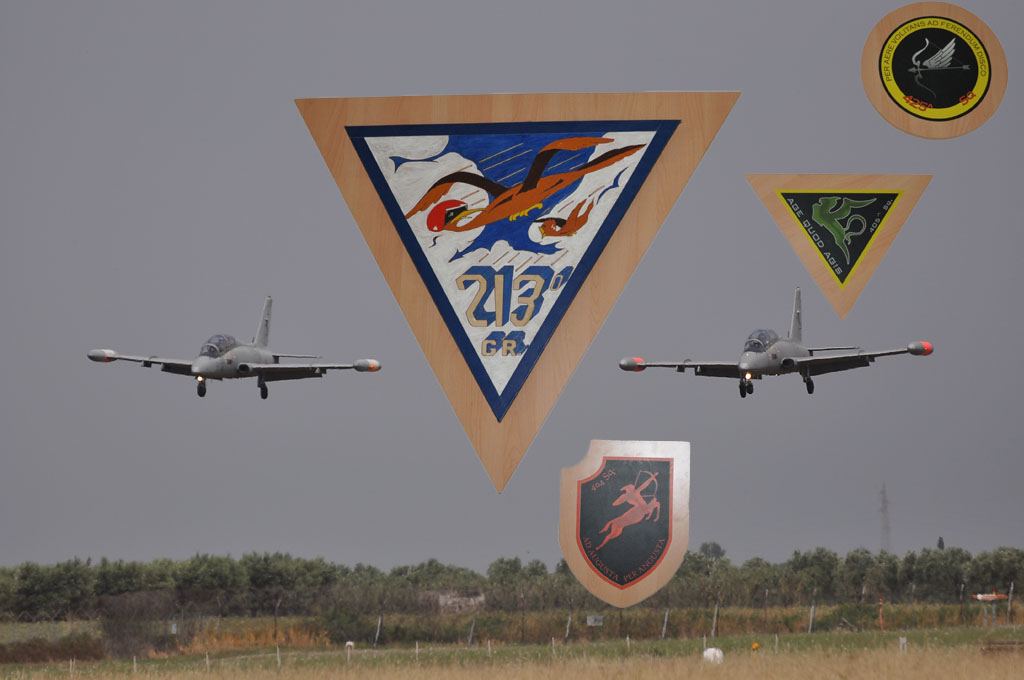 |
La storia del 213° Gruppo è legata agli eventi post armistizio dell’8 settembre 1943, contestuali alla rinascita della Regia Aeronautica. Il 3° Gruppo, assieme al 1° ed al 2°, viene costituito il 30 Novembre del 1945, successivamente al trasferimento della Scuola di pilotaggio di Leverano a Lecce (1° Novembre 1945), alle dipendenze del Reparto vengono assegnati la 5ª e la 6ª Squadriglia con il compito di svolgere l’Addestramento Basico Caccia e di 3° Periodo, ossia quello relativo all’ultima fase del conseguimento del Brevetto di Pilota Militare, mentre al 1° e 2° Gruppo, competono rispettivamente quello di 1° Periodo (Brevetto di Pilota d’Aeroplano) e di 2° Periodo (Addestramento Basico).
Il 3° Gruppo è dotato di velivoli Fiat G.8, Nardi Fn.305, Fiat G.50 “Freccia”, Macchi MC.200 “Saetta” e Saiman 200/202, questi ultimi utilizzati per il collegamento, successivamente vengono impiegati per l’Addestramento Caccia anche: MC.202 “Folgore”, MC.205 “Veltro”, Spitfire, Bell P 39 “Aira-Cobra”, Lockheed P 38 “Lightning I”, North American P 51 “Mustang” (dall’aprile 1949 al novembre 1958), North American T 6 “Texan”, Fiat G.59 (dall’aprile 1951 al novembre 1958), nonché i monomotori Macchi Ma.416, Macchi Bazzocchi MB.308 e Piaggio P.148 per il collegamento.
Il 1° Giugno 1954, il 3° Gruppo assume la nuova denominazione di 213° Gruppo, alle sue dipendenze la 404ª e la 405ª Squadriglia, denominazione che rimarrà tale sino ai giorni nostri, analoga sorte spetta al 1° Gruppo, rinominato 211° Gruppo Autonomo ed al 2° Gruppo ora 212° (402ª e 403ª Squadriglia).
Il 3° Gruppo, assieme al 2°, si occupa dell’Addestramento di 2° e 3° Periodo e dell’Addestramento Basico Caccia volando rispettivamente sui velivoli T 6, G.59 e P 51, mentre, per il collegamento vengono impiegati dei bimotori Beechcraft C 45 “Expeditor”.
Dal luglio del 1976, a seguito della messa in posizione quadro del 214° Gruppo, la 425ª Squadriglia viene assegnata al 213° Gruppo dove resta fino ai giorni nostri.
Il 1° ottobre del 1981, dopo vent’anni di attività sull’MB 326 e 400.000 ore di volo effettuate il 213° Gruppo effettua la transizione sul nuovo addestratore Aermacchi MB 339A. Il 2 agosto 1982 con l’introduzione del nuovo cacciabombardiere Tornado nella linea caccia dell’AM il Reparto inizia il 1° corso per navigatori/operatori di sistema.
A seguito della chiusura della Scuola Volo Basico Avanzato Aviogetti di Amendola nel 1995, il 213° Gruppo assume il compito definitivo e attuale di svolgere l’addestramento denominato Fase 3 che permette agli allievi il conseguimento del BPM (Brevetto Pilota Militare). |
 |
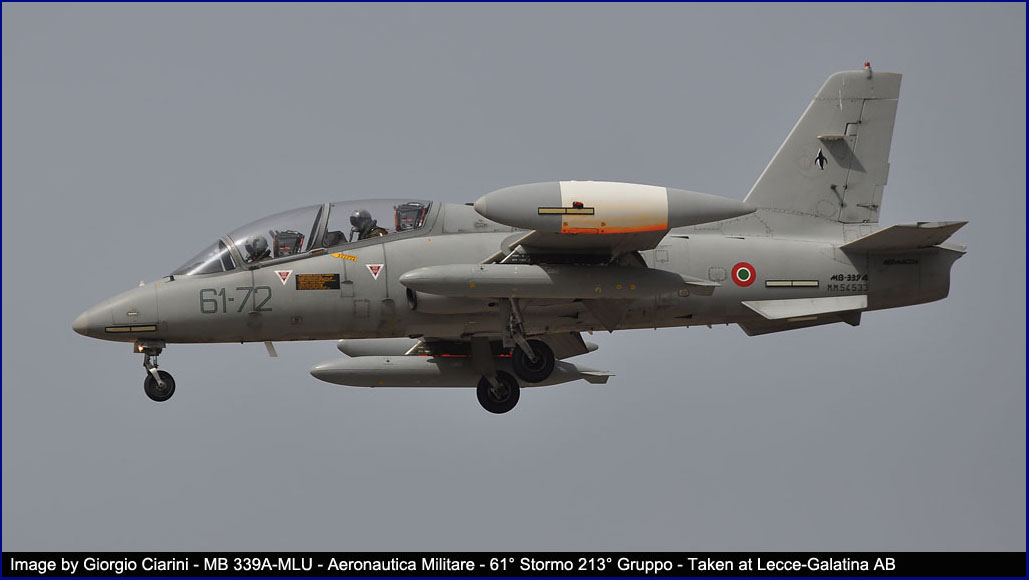 |
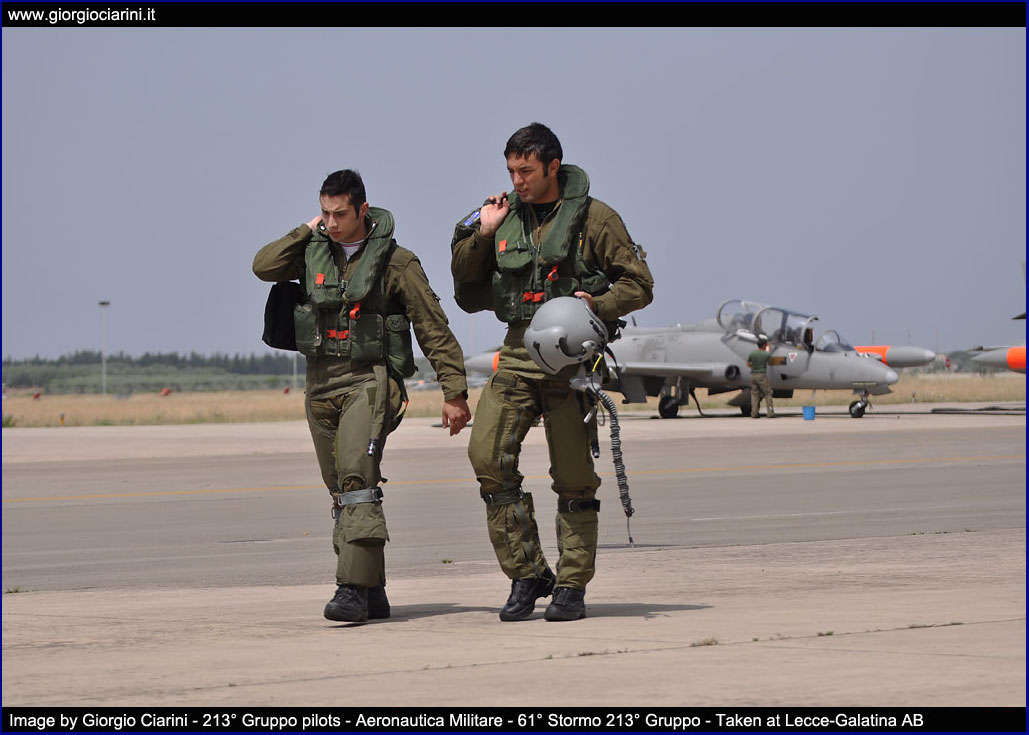
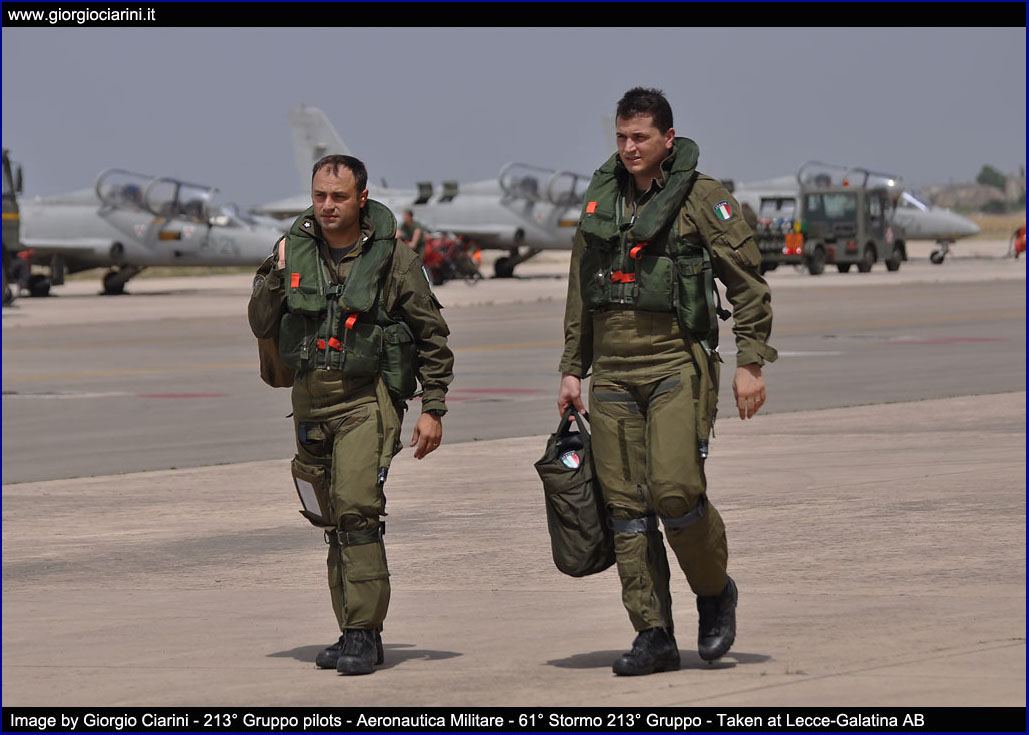
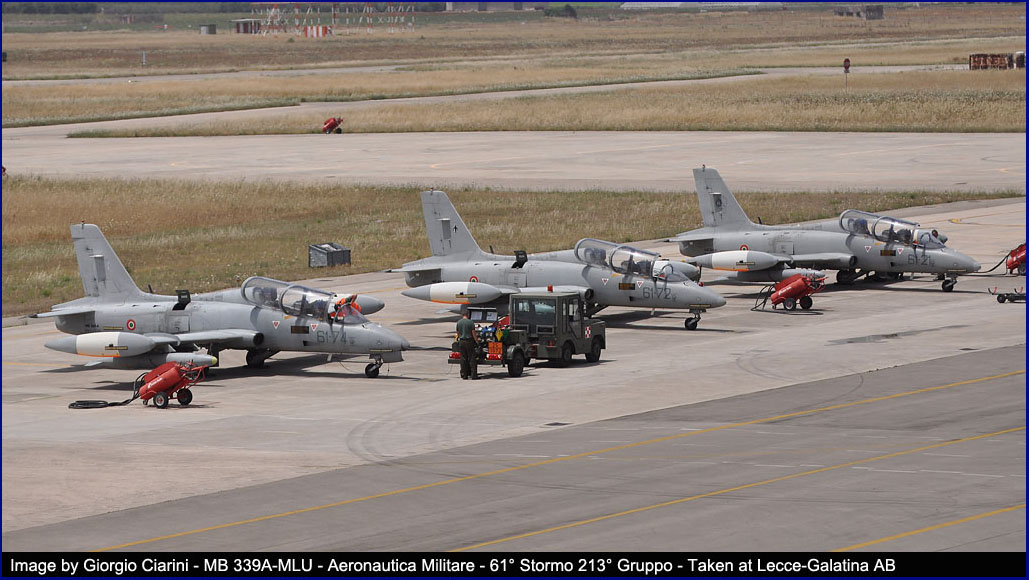
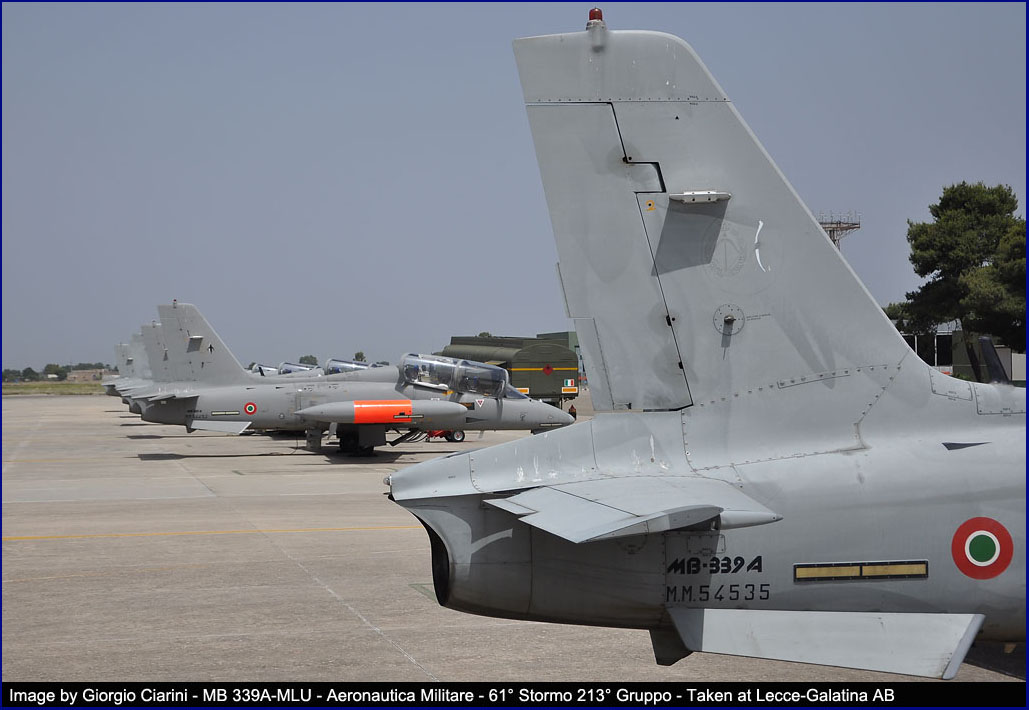
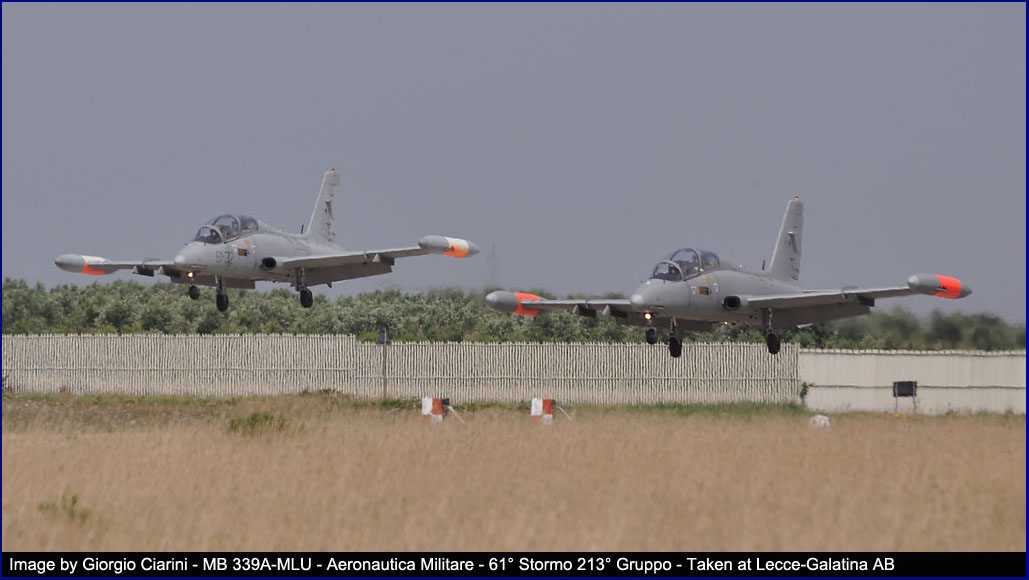
Prima di giungere in questa sezione dedicata al 213° Gruppo molti di voi avranno letto la parte iniziale dell’articolo dedicata al 61° Stormo, quindi tutti avranno ormai certamente compreso che le attività svolte presso la base aerea di Lecce-Galatina sono sinonimo di addestramento. La Scuola salentina è da sempre la location nella quale molti piloti possono coronare il sogno che vale tutta una vita, il punto di arrivo di molti anni passati a studiare e dopo aver percorso una strada in costante salita, quindi la presenza a Lecce può garantire il superamento dell’ultima barriera prima di diventare pilota dei più potenti aviogetti militari in servizio. Sicuramente è anche un passaggio tra i più difficoltosi, che mette a dura prova le capacità professionali di tutti i candidati. Riepilogando la situazione e collegando virtualmente le varie sezioni che compongono la struttura del 61° Stormo abbiamo: il 214° che si occupa della parte Ground School (Istruzione a terra) e dell’addestramento degli istruttori neo assegnati, il 212° si occupa del Lead In Fighter Training (Addestramento Avanzato) e per forza di cose manca un passaggio fondamentale per chiudere il cerchio, questo passaggio è esattamente posto a metà dell’iter addestrativo per diventare pilota da caccia. Per svolgere questa fase, come per le due appena ricordate, serve una struttura addestrativa di primo piano che tramite degli istruttori molto qualificati garantisce l’addestramento basico iniziale su aviogetti, il Reparto di cui fanno parte questi “attori” è il 213° Gruppo, e la sua dotazione di velivoli è basata completamente sull’MB 339A-MLU.
I piloti dopo aver svolto l’iter addestrativo (Fase 2) presso il 70° Stormo di Latina su SF 260EA, o in Grecia presso la Scuola di Kalamata su T 6 Texan II, vengono accolti presso il 213° Gruppo per svolgere il corso “BPM Fase 3 Brevetto di Pilota Militare”, se provenienti da Latina l’iter ha una durata totale di circa dieci mesi, se invece il pilota proviene dalla scuola ellenica svolgerà il corso denominato RPML Phase 3 (Reduced Military Pilot License), che ha una durata leggermente inferiore, nell’ordine degli otto mesi.
In questo scorcio di testo abbiamo visto quali sono le modalità con cui i piloti approdano al 213°, nelle prossime righe cercherò di sviluppare nel modo più chiaro possibile come viene svolto l’addestramento; faccio una breve precisazione dicendo che i numeri presi in esame nel testo a seguire sono indicativi, questi possono cambiare in base alle esigenze della Forza Armata o per variabili difficilmente preventivabili durante il percorso formativo. |
|
|
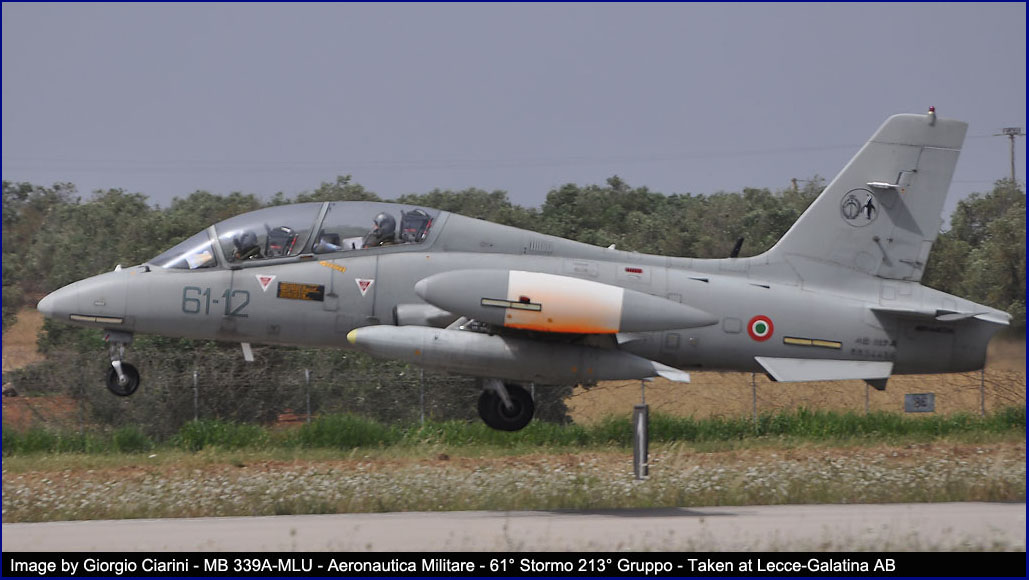
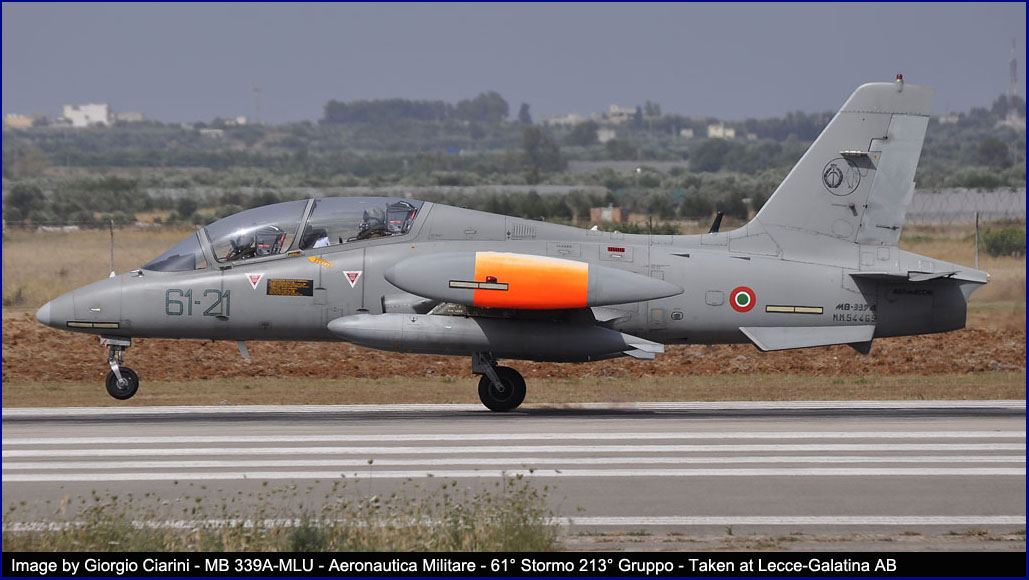
La fase iniziale del corso prevede 12 missioni di volo a vista che sono svolte rigorosamente in modalità VFR (Visual Flight Rules) con l’istruttore seduto nel posto posteriore dell’MB 339 Alpha che supervisiona e istruisce l’allievo, la 13a missione è quella sicuramente più importante per l’allievo perché è la prima in assoluto ad essere svolta come solista.
Oltre alle missioni sul velivolo sono di fondamentale importanza, specialmente prima della solista, quelle svolte sul simulatore di volo, finalizzate all’apprendimento delle procedure e della metodologia di risoluzione delle emergenze.
Successivamente sono svolte ulteriori 26 missioni di volo a vista di cui quattro come solista, che iniziano ad alternarsi con le missioni di volo strumentali e i simulatori. Nella fase iniziale e finale di questa sezione addestrativa sono svolti i primi due esami (per un totale di sei). Il passaggio successivo è quello di svolgere 12 missioni completamente strumentali utilizzando le radio assistenze come il Tacan (Tactical Air Navigation), il VOR (Very High Frequency Omnidirectional Radio Range) l’ILS (Instrumental Landing System) il GPS (Global Positioning System) e una volta completate tutte le missioni IFR (Instrumental Flight Rules) si esegue un successivo esame ovviamente su quest’ultima tipologia di volo.
Tornando un attimo alle missioni a terra con l’ausilio del simulatore, delle 37 prove in programma ne vengono svolte 14 per le procedure d’emergenza, nove per il volo strumentale e 14 per la navigazione IFR, a scadenze non prefissate per un refreshment sono inserite altre prove per testare la prontezza in caso d’emergenza. |
 |
Per quanto riguarda le missioni eseguite sino ad ora, ne vengono svolte alcune di tipo round robbin con partenza da Lecce, viene svolto uno o più avvicinamenti strumentali su un aeroporto intermedio come: Brindisi, Gioia del Colle, Bari, Grottaglie o Amendola, in ogni caso dislocati nel sud Italia, e quindi ritorno e atterraggio a Lecce.
Terminato questa fase si passa a quella successiva dove è inserito il volo in formazione (2 ship) con immancabile missione da solista, per un totale di 16 sortite che coprono circa 20 ore di volo, per la precisione metà missione è svolta come leader e la restante metà come gregario, questo serve per far acquisire all’allievo le necessarie capacità decisionali in una missione leggermente più complessa.
Terminata anche questa fase passiamo ora al volo notturno, il totale delle missioni è abbastanza limitato rispetto agli altri step, sono un totale di cinque missioni, per un ora ciascuna, il primo blocco di tre missioni ne prevede due con relativo istruttore a bordo eseguendole in modalità VFR; la caratteristica è di eseguire degli avvicinamenti strumentali sull’aeroporto di Brindisi, la terza è fatta con le medesime modalità però da solista. Il secondo blocco è invece composto da due missioni (round robbin) in modalità IFR con diversi avvicinamenti a Brindisi, Amendola e Gioia del Colle.
Il passaggio successivo comincia ad essere interessante, si parla di ulteriori 16 missioni con volo di navigazione svolto a bassa quota, sono circa 19 ore di volo svolte tutte in periodo diurno, le prime 12 avvengono con velivolo singolo, le rimanti quattro svolte all’interno di una formazione, le aree dove sono svolte queste missioni sono comprese tra la Basilicata e la Calabria sia su terra sia sul mare, al termine viene effettuato l’immancabile esame.
La parte finale dell’iter addestrativo prevede voli IFR con partenza da Lecce e arrivo in un qualsiasi aeroporto militare dislocato sul territorio italiano, e in caso di disponibilità di fondi, anche estero. Per l’ultima classe, ad esempio, tutti gli allievi hanno potuto svolgere una missione con pernottamento in Grecia, particolarmente utile per l’apprendimento delle procedure necessarie per un volo “fuori sede estero”. Le missioni svolte in quest’ambito sono circa 12, mentre la penultima missione viene utilizzata come esame finale (andata e ritorno) e l’ultima missione è una missione da solista, in cui l’allievo applica tutte le conoscenze apprese andando e tornando da un altro aeroporto in maniera completamente autonoma e senza istruttore a bordo.
A questo punto abbiamo spiegato come avviene l’addestramento dell’allievo pilota, purtroppo non tutti riescono però a raggiungere il prestigioso traguardo di diventare pilota da combattimento e siccome il percorso è molto lungo e irto di difficoltà possono crearsi diverse situazioni. Una di queste può essere che il pilota non superi uno degli esami di fine blocco che abbiamo visto in precedenza, in questo caso è concessa una seconda possibilità per ripetere l’esame, nel caso non dovesse farcela è sottoposto ad un altro controllo di progresso iniziale (CPF), se anche in questo caso non supera il CPF l’allievo è sottoposto al Consiglio Permanente di Attitudine che può proporre per la dismissione dal ruolo, a questo punto il Comando delle Scuole decide per lo spostamento. |
 |
Alla fine del corso, in base al rendimento e all’attitudine dimostrata da ogni singolo allievo, gli istruttori del 213° Gruppo, riuniti in seduta plenaria, decidono per quale linea suggerirne l’impiego (Aerotattica o Supporto). In base alle esigenze di Forza Armata ed al suggerimento degli istruttori, gli allievi vengono assegnati dall’Aeronautica Militare ad un reparto Aerotattico (ad es. EF 2000 Typhoon, F 16, Tornado, AMX o Predator) o supporto (ad es. C 130, Airbus, Atlantic, P 180, elicotteri). Agli allievi divenuti finalmente piloti militari, viene comunicata ufficialmente la destinazione in occasione di una suggestiva cerimonia, denominata “ASSIGNMENT NIGHT”, a cui partecipa tutto lo Stormo e dove sono invitati i parenti dei neo-piloti,.
Infine, a completamento dell’iter addestrativo e a coronamento di un sogno, l’ambita Aquila Turrita, simbolo del Pilota Militare, viene appuntata pubblicamente sul petto dei nuovi piloti brevettati nella cerimonia formale della “Consegna delle Aquile”, alla presenza delle massime autorità militari, civili e religiose.
Mi sembra giusto a questo punto fare una considerazione in termini numerici su quanti frequentatori prendano parte annualmente alla Fase 3, tenendo come riferimento il 2010, quindi per il corso Falco V, hanno frequentato i corsi 25 allievi, di cui un allievo di sesso femminile, e tutti di nazionalità italiana. Come abbiamo detto prima alcuni allievi non ottengono l’abilitazione e in questo caso per “continuare” a dare dei numeri facciamo riferimento alle statistiche, attenzione che però tengono conto anche degli anni passati dove erano presenti più frequentatori, queste statistiche riportano che un 7-10 % di allievi non conseguono la necessaria abilitazione e quindi transitano nel ruolo delle Armi.
Come riferimento principale per descrivere il succitato iter addestrativo ho considerato delle missioni svolte da un allievo proveniente dalla Fase 2 svolta a Latina, nel caso l’allievo provenga dal corso paritetico svolto in Grecia si verificherebbe una riduzione di circa 25 missioni sul totale di 100, o comunque in percentuale, il motivo di questa riduzione è da ricercarsi nel fatto che presso la Scuola di Kalamata vengono svolte una quantità superiore di ore di volo, che inevitabilmente portano ad una riduzione durante lo svolgimento della Fase 3, stesso discorso per la fase addestrativa al simulatore con un riduzione di circa il 10%.
Ora mi sembra giusto anche evidenziare chi sono gli “attori principali” che svolgono l’importante funzione di istruttore, tutti i piloti che svolgono questo particolare incarico provengono dai reparti della Squadra Aerea o dal Comando delle Scuole, quindi sono tutti piloti con molte ore di volo alle spalle e con caratteristiche idonee allo svolgimento del ruolo loro affidato.
Per tutti i futuri istruttori che approdano alla Scuola di Lecce vale la regola che prima di iniziare a svolgere l’attività di istruzione devono a loro volta frequentare dei corsi ad hoc presso il 214° GIP, dove conseguono la necessaria abilitazione.
Il tempo di permanenza presso la Scuola varia in base alle esigenze di Forza Armata, ma solitamente sono tre anni per i piloti usciti dall’Accademia, quattro anni per i piloti di Complemento, per entrambi una volta terminato il periodo come istruttore solitamente c’è il ritorno ai reparti operativi, oppure possono essere destinati ad incarichi diversi.
Sempre rimanendo in tema di piloti istruttori, il 213° Gruppo annovera regolarmente tra le propria fila un pilota “di scambio” della Fuerza Aerea Argentina, egli generalmente proviene da reparti da caccia o caccia bombardiere (solitamente linea Mirage o Skyhawk), e contribuisce con la propria esperienza ad arricchire la gamma di competenze professionali disponibile per la formazione dei piloti militari.
Ora non posso esimermi, come di consuetudine, di accennare qualcosa sul futuro del 213°, prevedibilmente sarà abbastanza stabile per quanto riguarda i programmi addestrativi, l’unico fattore innovativo sarà l’acquisizione dei 339CD, ora in carico al 212° Gruppo, in sostituzione degli “ormai” vetusti MB 339A-MLU, questo passaggio avverrà contestualmente alla consegna dei nuovi addestratori T 346 Master al 212° Gruppo, un altro lieve fattore di cambiamento sarà portato dalla “messa a regime” della nuova Scuola multinazionale, lieve perché ormai è dal 2007 che i reparti di volo hanno lavorato sull’internalizzazione delle pubblicazioni, dei briefing e delle lezioni necessarie all’addestramento dei piloti militari. |
|
|
|
Comandante
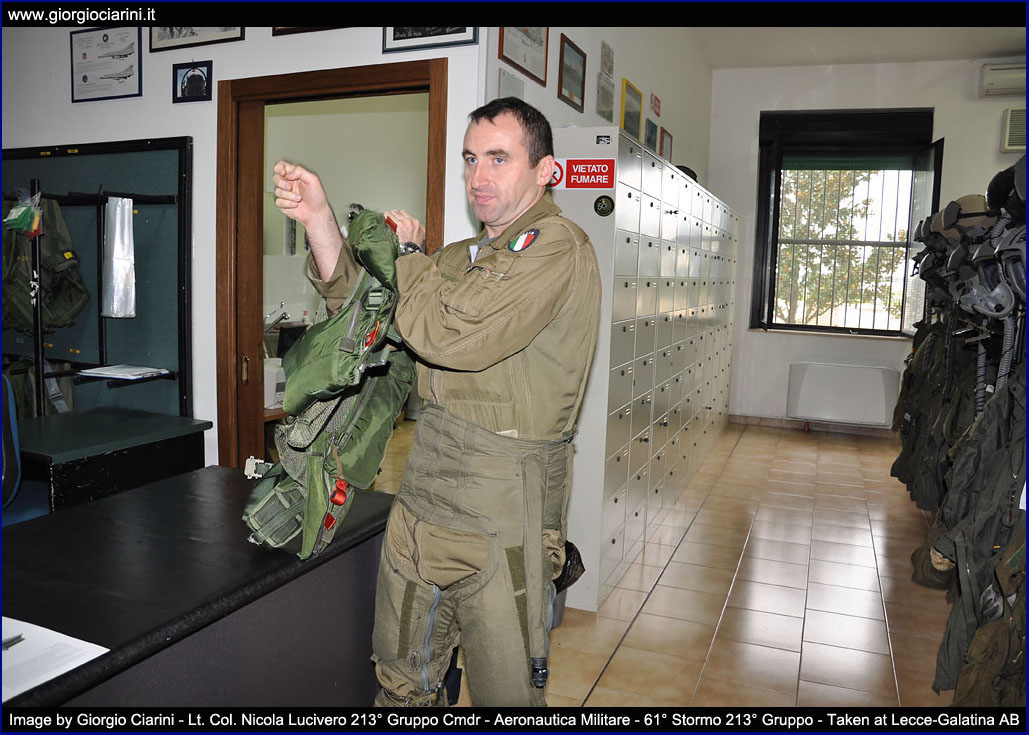
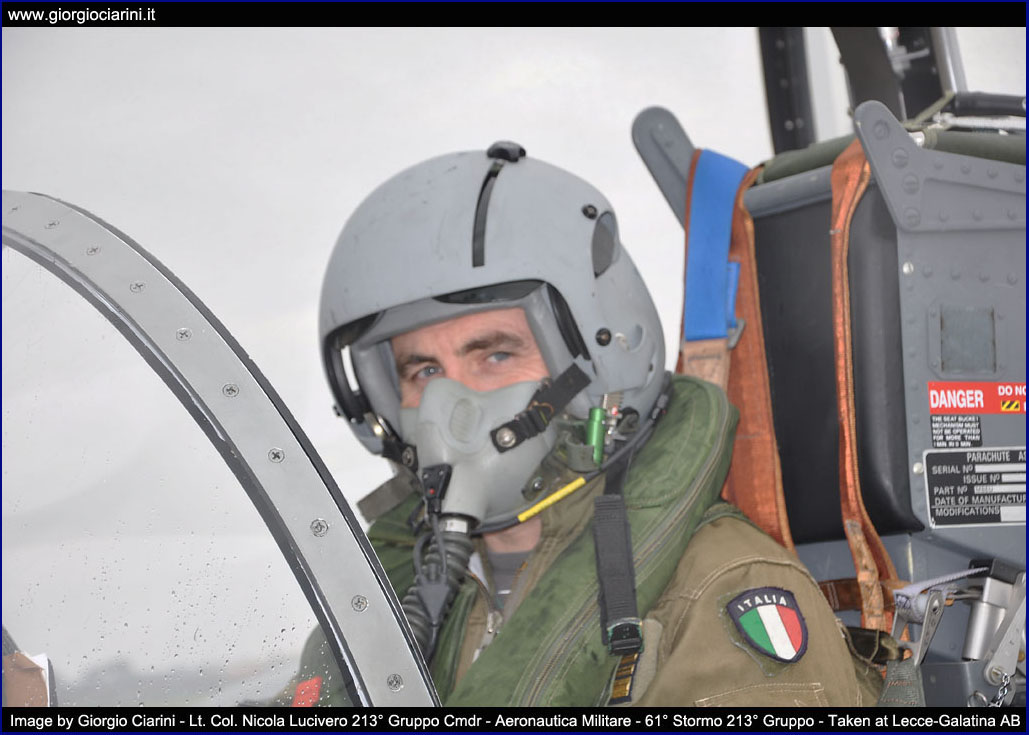
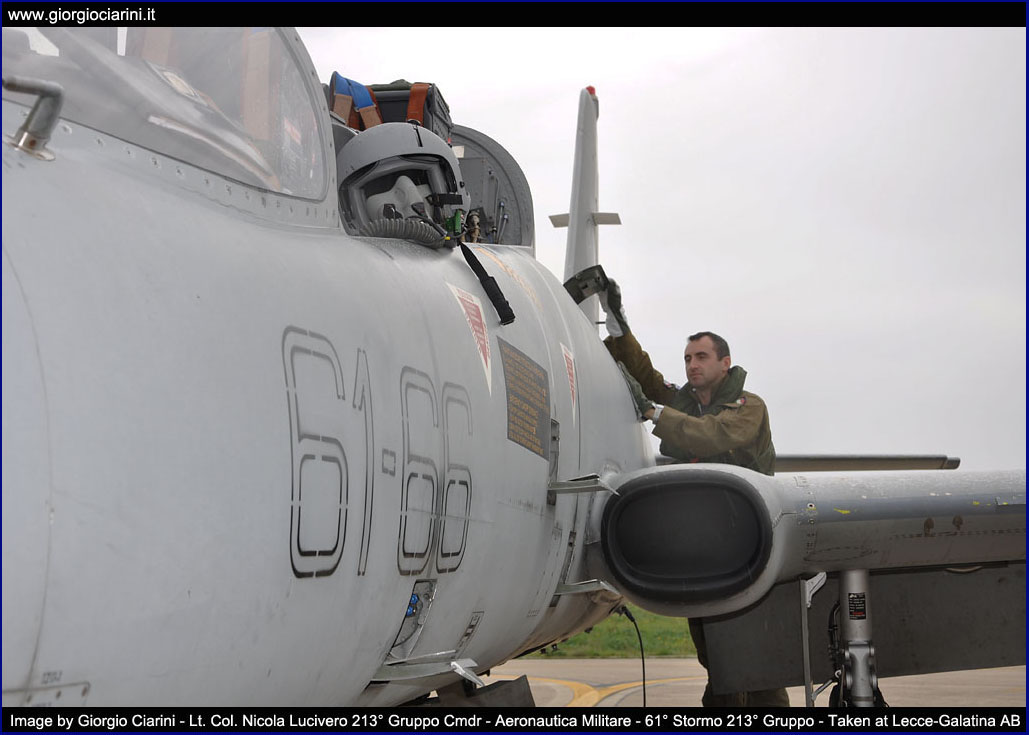
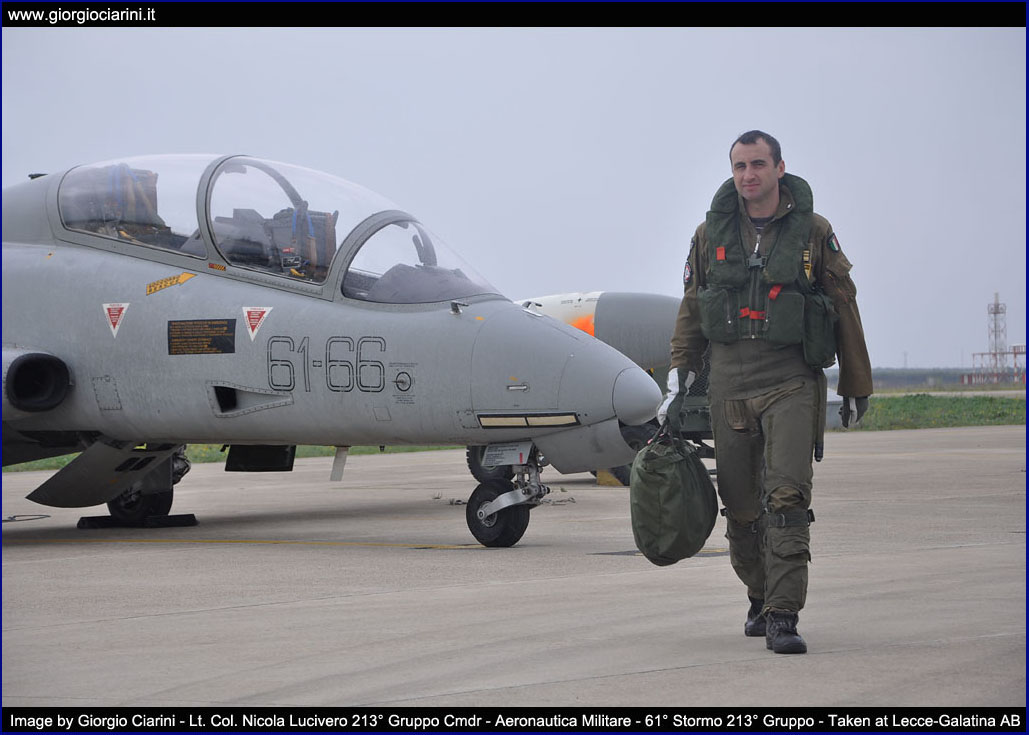
L’attuale Comandante del 213° Gruppo è il Tenente Colonnello Nicola Lucivero, nato a Bari nel 1972 si è arruolato in Accademia Aeronautica nel 1990, il 15 giugno del 1995 ottiene il BPM (Brevetto Pilota Militare) dopo aver frequentato il corso di pilotaggio su velivoli T 37 e T 38 presso la Base Aerea di Vance (Oklahoma) negli Stati Uniti. Successivamente, presso la Little Rock AFB (Arkansas) ha frequentato il corso di Pilot Mission Qualification sul velivolo C 130E.
Al rientro in Italia nel novembre del 1995 è assegnato alla 46ª Brigata Aerea di Pisa, durante la permanenza sulla base pisana egli ricopre i seguenti incarichi:
- Comandante della 173ª Squadriglia del 50° Gruppo Volo;
- UNITREP per la 46ª Brigata Aerea presso la 5th ATAF di Vicenza;
- Capo Nucleo Cartografico;
- Capo Sottonucleo Piani e Capo Sottonucleo Operazioni Correnti del 50° Gruppo;
- Pilota Capo Equipaggio C 130H della Cellula Voli NAI di Abu Dhabi (Emirati Arabi Uniti) per le operazioni in Afghanistan;
- Capo Nucleo Operazioni del 50° Gruppo;
- Capo Equipaggio C 130J presso il 7º ROA per le operazioni in Iraq ed Afghanistan;
Terminato il periodo presso la 46ª Brigata nel novembre del 2005 viene assegnato al 213° Gruppo del 61° Stormo di Lecce Galatina dove ricopre i seguenti incarichi:
- Capo Nucleo Operazioni del 213° Gruppo Volo;
- Capo Sezione Operazioni e Addestramento del 213° Gruppo Volo;
- Capo Sezione Piani e Operazioni dell’Ufficio Operazioni di Stormo;
- Capo Ufficio Operazioni;
Durante le attività svolte sia alla 46ª Brigata Aerea che ora al 61° Stormo il Ten. Col. Lucivero ha avuto modo di frequentare i seguenti corsi:
Corso Crew Resource Management presso la 46ª Brigata Aerea;
Corso Modulo “A” E “B” e Corso Normale presso la Scuola di Guerra Aerea di Firenze;
Corso Istruttore Tattiche Operative/TT C130J;
Corso NVG presso il Centro Sperimentale Volo di Pratica di Mare;
Corso Advanced Airlift Tactics Training Center presso la base aerea di Rosecrans (Missouri)
Corso Multi Crew Coordination presso il centro Addestramento Alitalia di Fiumicino;
Corso Istruttore di Volo e corso Esaminatore presso il 61° Stormo;
Corso di qualificazione Sicurezza Volo;
14° Corso Comando presso l’ISMA di Firenze.
Il Ten. Col. Lucivero è insignito delle seguenti onorificenze:
- Croce Commemorativa per le attività di soccorso internazionale – Operazione ALBA;
- Medaglia Militare d’argento per lunga navigazione aerea;
- Medaglia NATO per le operazioni in Kosovo;
- Distintivo Bellico – Specialità Trasporto – GRADO ORO;
- Croce Commemorativa per la Missione Militare di pace “SFOR” in Bosnia;
- Croce Commemorativa per la Missione Militare di pace in Etiopia ed Eritrea;
- Croce Commemorativa per attività di Soccorso Internazionale in Macedonia ed Albania;
- Croce d’Argento per anzianità di Servizio;
- Croce Commemorativa per la partecipazione alle operazioni di mantenimento della sicurezza internazionale per la pacificazione in Afghanistan.
- Croce Commemorativa per la partecipazione alle operazioni di soccorso umanitario internazionale nell’ambito della missione in Iraq.
Al suo attivo il Tenente Colonnello ha circa 4.100 ore di volo sui seguenti velivoli: SF 260, T 37, T 38, C 130E, C 130H, C 130J, MB 339A, CD e PAN, Hawk 108 e L 39 Albatros.
|
 |
 |
 |
 |
|
English translation
The story of the 213° Gruppo is linked to the post-armistice events of 8 September 1943, contextual to the rebirth of the Regia Aeronautica. The 3° Gruppo, together with the 1° and the 2°, is constituted the 30 November of 1945, successively to the transfer of the School of pilotage of Leverano to Lecce (1 November 1945) the 5ª and 6ª Squadriglia are assigned to carry out the Basic Fighter Training and the 3° Periodo, that is, the last phase of obtaining the Brevetto di Pilota Militare, while the 1° and 2° Gruppo, compete respectively that of 1° Periodo (Brevetto di Pilota d'Aeroplano) and 2° Periodo (Basic Training).
The 3° Gruppo is equipped with aircraft Fiat G.8, Nardi Fn.305, Fiat G.50 "Freccia", Macchi MC.200 "Saetta" and Saiman 200/202, the latter used for the liaison, later are used for fighter training also: MC.202 "Folgore", MC.205 "Veltro", Spitfire, Bell P 39 "Aira-Cobra", Lockheed P 38 "Lightning I", North American P 51 "Mustang" (April 1949 to November 1958), North American T 6 "Texan", Fiat G.59 (April 1951 to November 1958), as well as Macchi Ma.416 single engines, Macchi Bazzocchi MB.308 and Piaggio P.148 for liaison.
On 1st June 1954, the 3° Gruppo took on the new name of 213° Gruppo, under its command the 404ª and 405ª Squadriglia, a name that will remain so until the present day, similar to the 1° Gruppo, renamed 211° Gruppo Autonomo and the 2° Gruppo now 212° (402ª and 403ª Squadriglia).
The 3° Gruppo, together with the 2°, is responsible for the training of 2° Periodo and 3° Periodo and the Basic Training Fighter flying respectively on the aircraft T 6, G.59 and P 51, while, for the liaison are used the twin-engined Beechcraft C 45 "Expeditor".
Since July 1976, following the introduction of the 214° Gruppo, the 425ª Squadriglia has been assigned to the 213° Gruppo, where it remains to this day.
On October 1, 1981, after twenty years of operation on the MB 326 and 400,000 flight hours on the 213° Gruppo Volo makes the transition on the new trainer Aermacchi MB 339A. On 2 August 1982, with the introduction of the new Tornado fighter bomber in the AM fighter line, the Unit began the 1st course for navigators/system operators.
Following the closure of the Scuola Volo Basico Avanzato Aviogetti of Amendola in 1995, the 213° Gruppo assumes the definitive and current task of carrying out the training called Phase 3 that allows students to achieve the BPM (Brevetto Pilota Militare).
Before arriving in this section dedicated to the 213° Gruppo many of you will have read the initial part of the article dedicated to the 61° Stormo, so everyone will have now certainly understood that the activities carried out at the air base of Lecce-Galatina are synonymous with training. The Salento School has always been the location in which many pilots can crown the dream that is worth a lifetime, the arrival point of many years spent studying and after traveling a road in constant uphill, therefore the presence in Lecce can guarantee the overcoming of the last barrier before becoming pilot of the most powerful military jets in service. It is certainly also one of the most difficult steps, which puts a strain on the professional skills of all candidates. Summing up the situation and virtually connecting the various sections that make up the structure of the 61° Stormo we have: the 214° which deals with the Ground School part (Ground Instruction) and the training of newly assigned instructors, the 212° has taken care of the Lead In Fighter Training (Advanced Training) and for strength of things lacks a fundamental step to close the circle, this step is exactly placed in the middle of the training process to become a fighter pilot. To carry out this phase, as for the two mentioned above, you need a prominent training structure that through highly qualified instructors guarantees the initial basic training on jets, the Unit of which these "actors" are part It is the 213° Gruppo, and its aircraft equipment is based entirely on the MB 339A-MLU.
The pilots after having carried out the training process (Phase 2) at the 70° Stormo of Latina on SF 260EA, or in Greece at the School of Kalamata on T 6 Texan II, are welcomed at the 213° Gruppo to carry out the course "BPM Phase 3 Brevetto di Pilota Militare", if coming from Latina the process has a total duration of about ten months, if instead the pilot comes from the Hellenic School will take the course called RPML Phase 3 (Reduced Military Pilot License), which has a slightly shorter duration, in the order of eight months.
In this glimpse of text we have seen what are the ways in which the pilots land to the 213°, in the next few lines I will try to develop as clearly as possible how the training is carried out; I make a brief clarification saying that the numbers examined in the text below are indicative, these can change according to the needs of the Armed Force or for variables difficult to predict during the training.
The initial phase of the course includes 12 visual flight missions that are carried out strictly in VFR mode (Visual Flight Rules) with the instructor sitting in the rear seat of the MB 339 Alpha that supervises and instructs the student, the 13rd mission is certainly the most important for the student because it is the first ever to be carried out as a soloist.
In addition to the missions on the aircraft are of fundamental importance, especially before the solo, those carried out on the flight simulator, aimed at learning the procedures and methodology of emergency resolution.
Then there are 26 additional missions of flight on sight, four of which as soloist, which begin to alternate with instrumental flight missions and simulators. In the initial and final phase of this training section the first two exams are held (for a total of six). The next step is to carry out 12 fully instrumental missions using radio assists such as the Tacan (Tactical Air Navigation), the VOR (Very High Frequency Omnidirectional Radio Range) the ILS (Instrumental Landing System) the GPS (Global Positioning System) and once completed all the missions IFR (Instrumental Flight Rules) is performed a subsequent examination of course on the latter type of flight.
Returning for a moment to the ground missions with the help of the simulator, of the 37 scheduled tests are carried out 14 for emergency procedures, nine for instrument flight and 14 for IFR navigation, other tests to test readiness in the event of an emergency are inserted at fixed intervals for a refreshment.
As for the missions carried out so far, are carried out some Round Robbin with departure from Lecce, is carried out one or more instrumental approaches on an intermediate airport such as: Brindisi, Gioia del Colle, Bari, Grottaglie or Amendola, in any case located in southern Italy, and then return and landing in Lecce.
After this phase we move on to the next one where the flight in formation (2 ships) with inevitable solo mission, for a total of 16 sorties covering about 20 hours of flight, to be precise half mission is carried out as leader and the remaining half as gregarious, this is to help the student acquire the necessary decision-making skills in a slightly more complex mission.
After this phase we now move to the night flight, the total of the missions is quite limited compared to the other steps, they are a total of five missions, for one hour each, the first block of three missions provides two with its instructor on board performing them in VFR mode; the characteristic is to perform the instrumental approaches on the airport of Brindisi, the third is made with the same modalities but solo. The second block consists of two missions (round Robbin) in IFR mode with several approaches to Brindisi, Amendola and Gioia del Colle.
The next step begins to be interesting, we talk about additional 16 missions with navigation flight carried out at low altitude, are about 19 hours of flight all carried out during the day, the first 12 take place with single aircraft, the remaining four turns within a formation, the areas where these missions are carried out are included between Basilicata and Calabria both on land and on the sea, at the end is carried out the inevitable examination.
The final part of the training process involves IFR flights departing from Lecce and arriving at any military airport located on Italian territory, and in case of availability of funds, even abroad. For the last class, for example, all students were able to carry out an overnight stay mission in Greece, particularly useful for learning the procedures necessary for a flight "abroad". The missions carried out in this field are about 12, while the penultimate mission is used as a final exam (round trip) and the last mission is a solo mission, where the student applies all the knowledge learned by going to and from another airport completely independently and without an instructor on board.
At this point we explained how the training of the student pilot, unfortunately not everyone can reach the prestigious goal of becoming a combat pilot and since the path is very long and fraught with difficulties can create different situations. One of these may be that the pilot does not pass one of the end of the block exams we have seen previously, in this case a second chance is granted to repeat the exam, in the event he does not succeed is subjected to another initial progress check (CPF or Controllo di Progresso Iniziale), If even in this case, the student does not pass the CPF, the student is submitted to the Consiglio Permanente di Attitudine (Permanent Council of Aptitude) that he can propose for the dismissal from the role, at this point the Comando delle Scuole decides for the displacement.
At the end of the course, based on the performance and attitude shown by each individual student, the instructors of the 213° Gruppo, gathered in plenary session, decide for which line to suggest the use (Aerotactical or Support). Depending on the needs of the Armed Force and the suggestions of the instructors, the students are assigned by the Aeronautica Militare to an aerotactical units (e.g. EF 2000 Typhoon, F 16, Tornado, AMX or Predator) or support (e.g. C 130, Airbus, Atlantic, P 180, helicopters). The students finally become military pilots, is officially notified of the destination on the occasion of a suggestive ceremony, called "ASSIGNMENT NIGHT", in which all the Stormo participates and where relatives of the new pilots are invited.
Finally, to complete the training process and to crown a dream, the coveted Aquila Turrita, symbol of the Military Pilot, is publicly pinned on the chest of the new pilots patented in the formal ceremony of the "Delivery of the Eagles" in the presence of the highest military, civil and religious authorities.
I think it is right at this point to make a numerical consideration of how many participants take part annually in Phase 3, taking as a reference 2010, then for the Falco V course, 25 students attended the courses, including a female student, and all of Italian nationality. As we said before some students do not get the qualification and in this case to "continue" to give the numbers we refer to statistics, attention that also take into account the past years where there were more frequenters, these statistics show that 7-10 % of students do not obtain the necessary qualification and therefore pass into the role of the “Armi” (Weapons).
As a main reference to describe the above training process I considered the missions carried out by a student from Phase 2 carried out in Latina, if the student comes from the joint course held in Greece there would be a reduction of about 25 missions out of the total of 100, or in any case in percentage, the reason for this reduction lies in the fact that the School of Kalamata has more flying hours, which inevitably lead to a reduction during Phase 3, same thing for the training phase to the simulator with a reduction of about 10%.
Now it seems right to highlight who are the "main actors" who perform the important function of instructor, all pilots who carry out this particular task come from the units of the Squadra Aerea (Air Group) or the Comando delle Scuole, so they are all pilots with many hours of flight behind them and with characteristics suitable for the performance of the role entrusted to them.
For all future instructors arriving at the School of Lecce it is the rule that before starting to carry out the activity of education must in turn attend ad hoc courses at the 214° GIP, where they earn the necessary qualification.
The time of stay at the School varies according to the needs of the Armed Force, but usually it is three years for pilots who have left the Accademia, four years for pilots of Complement, for both once the period as an instructor usually ends there is the return to the operational units, or they can be assigned to different assignments.
Remaining on the subject of instructor pilots, the 213° Gruppo has regularly among its ranks a pilot "exchange" of the Argentina Air Force, he generally comes from fighter or fighter bomber (usually line Mirage or Skyhawk), and contributes with its own experience to enrich the range of professional skills available for the training of military pilots.
Now I cannot avoid, as usual, to mention something about the future of the 213°, predictably will be quite stable with regard to training programs, the only innovative factor will be the acquisition of the 339CD, now in charge of the 212° Gruppo. Replacing the "by now" old MB 339A-MLU, this step will take place at the same time as the delivery of the new trainers T 346 Master to the 212° Gruppo, another slight change factor will be brought by the "commissioning" of the new multinational School, light because it is now since 2007 that the Gruppi Volo have worked on the internalization of publications, briefings and lessons necessary for the training of military pilots.
Commander
The current Commander of the 213° Gruppo is Lieutenant Colonel Nicola Lucivero, born in Bari in 1972 he joined the Accademia Aeronautica (Air Avademy) in 1990, on June 15, 1995 he obtains the BPM (Brevetto Pilota Militare) after attending the pilot course on T 37 and T 38 aircraft at Vance Air Base (Oklahoma) in the United States. Subsequently, at the Little Rock AFB (Arkansas) he attended the course of Pilot Mission Qualification on the aircraft C 130E.
On his return to Italy in November 1995 he was assigned to the 46ª Brigata Aerea of Pisa, during his stay on the Pisa base he held the following positions:
- Commander of the 173ª Squadriglia of the 50° Gruppo Volo;
- UNITREP for the 46ª Brigata Aerea at the 5th ATAF in Vicenza;
- Head of Cartographic Core;
- Sub-Nucleus Chief Plans and Sub-Nucleus Chief Current Operations of the 50° Gruppo.
- NAI Flight Cell Pilot C 130H in Abu Dhabi (United Arab Emirates) for operations in Afghanistan;
- Head of Operations Unit of the 50° Gruppo;
- Crew Chief C 130J at the 7° ROA for operations in Iraq and Afghanistan;
After the period at the 46ª Brigata Aerea in November 2005, he was assigned to 213° Gruppo of 61° Stormo of Lecce-Galatina, where he held the following positions:
- Operations Nucleus Chief of the 213° Gruppo Volo;
- Section Chief Operations and Training of 213° Gruppo Volo;
- Head of Plans and Operations Section of the Stormo Operations Office;
- Head of Operations Office;
During the activities carried out both to the 46ª Brigata Aerea and now to the 61° Stormo the Ten. Col. Lucivero had the opportunity to attend the following courses:
Crew Resource Management Course at the 46ª Brigata Aerea;
Module "A" and "B" Course and Normal Course at the School of Aerial War of Firenze;
Operational Tactical Instructor Course/TT C 130J;
Course NVG at the Reparto Sperimentale Volo (Experimental Center Flight) of Pratica di Mare;
Advanced Airlift Tactics Training Center course at Rosecrans air base (Missouri)
Multi Crew Coordination Course at the Alitalia Training Center of Fiumicino;
Flight Instructor Course and Examiner Course at the 61° Stormo;
Qualification course Flight Safety;
14° Command course at the ISMA in Firenze.
The Lt. Col. Lucivero is awarded the following honours:
- Commemorative Cross for International Relief Activities - Operation ALBA;
- Silver Military Medal for long air navigation;
- NATO Medal for Operations in Kosovo;
- Military Badge - Transportation Speciality - GOLD GRADE;
- Commemorative Cross for the Military Peace Mission "SFOR" in Bosnia;
- Memorial Cross for the Military Peace Mission in Ethiopia and Eritrea;
- Memorial Cross for International Relief Activities in Macedonia and Albania;
- Silver Cross for seniority of service;
- Commemorative Cross for participation in international peacekeeping operations in Afghanistan.
- Commemorative Cross for the participation in international humanitarian relief operations as part of the mission in Iraq.
The Lieutenant Colonel has approximately 4,100 flight hours on the following aircraft: SF 260, T 37, T 38, C 130E, C 130H, C 130J, MB 339A, CD and PAN, Hawk 108 and L 39 Albatros.
|
|